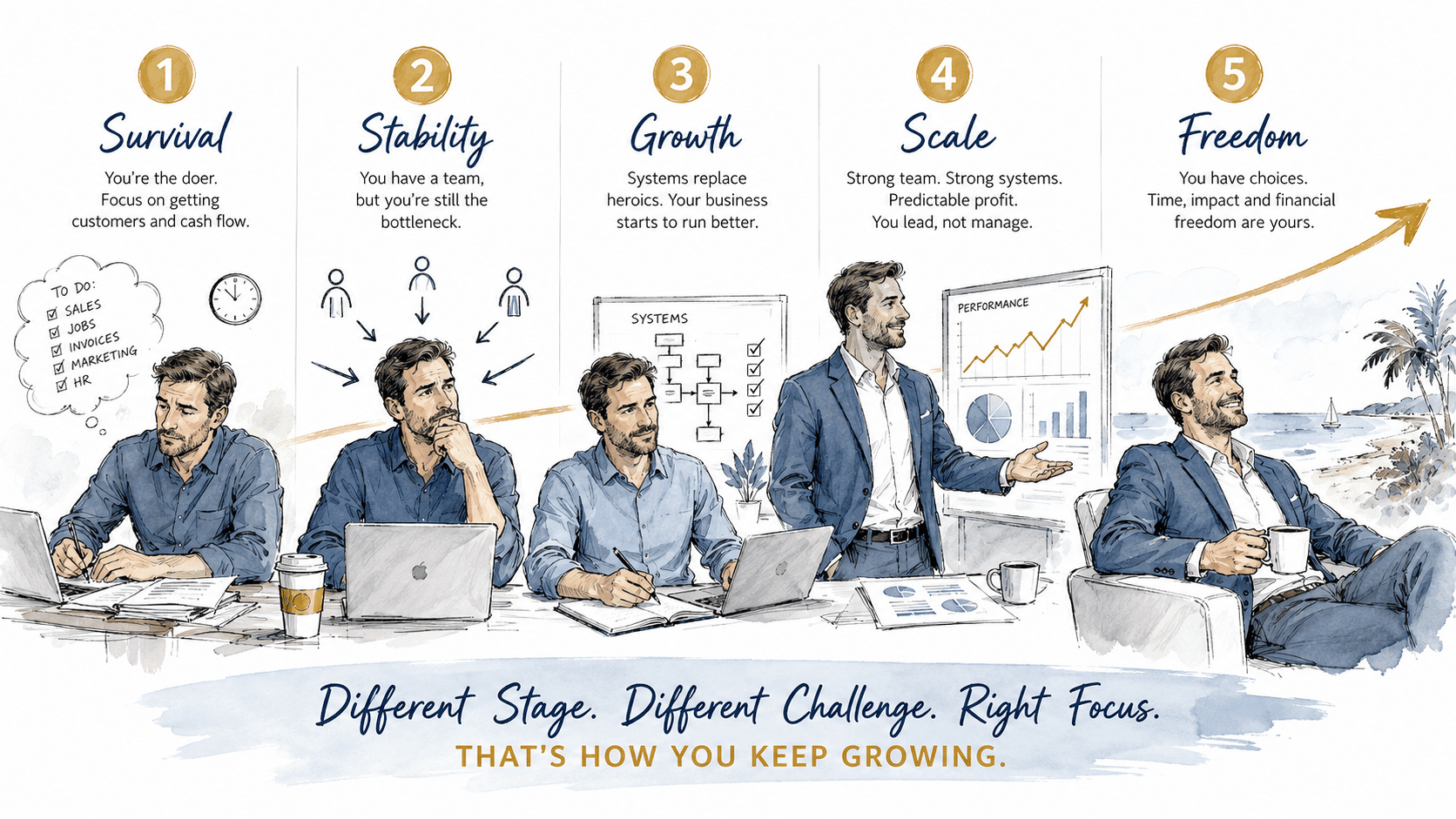
Every Business Hits Different Challenges as It Grows
Every successful business moves through predictable stages of growth. Each stage brings new opportunities, but also new problems that require a different way of thinking.
If your business already feels like it’s growing but you’re worried about burning out, read our guide on How to Scale a Small Business Without Burning Out which explains how to grow sustainably without sacrificing your life.
Stage 1: Survival
The business depends entirely on you.
At this stage you’re wearing every hat:
- Sales
- Marketing
- Operations
- Customer service
- Administration
- Finance
You’re working long hours just to keep everything moving.
Cash flow feels unpredictable.
Every new client creates more work rather than more freedom.
Signs you’re in the Survival Stage
- You’re working 60+ hours every week.
- Revenue changes month to month.
- You struggle to take holidays.
- Every customer issue lands on your desk.
- You’re constantly reacting instead of planning.
Your priority
Stop chasing everything.
Instead, focus on:
- Consistent lead generation
- Reliable pricing
- Healthy cash flow
- Building repeatable processes
Without these foundations, growth simply creates more chaos.
Your priority should be building predictable systems rather than simply working longer hours. A structured 90-Day Planning System can help you focus on the activities that create consistent growth.
Stage 2: Stability
The business is profitable, but you’re still the bottleneck.
Revenue becomes more predictable.
You hire your first employees.
Customers begin referring other customers.
On paper, everything looks positive.
But you’re still making every important decision.
Your staff constantly ask questions.
You approve every quote.
Nothing moves unless you’re involved.
Most owners recognise this one.
This is where many businesses become trapped.
Signs you’ve reached Stability
- Revenue is consistent.
- You have employees.
- You’re constantly interrupted.
- Holidays feel impossible.
- Growth has slowed.
At this stage, your biggest problem isn’t marketing.
It’s leadership.
Many owners also begin noticing they’re busy without becoming more profitable. If that’s you, read Why Your Business Feels Busy But Not Profitable
Stage 3: Growth
Systems begin replacing heroics.
This is where genuine business growth starts.
Instead of solving every problem yourself, you begin building systems that solve problems automatically.
You develop:
- Clear processes
- Accountability
- Team leaders
- Better reporting
- Financial visibility
Your team starts making decisions without constantly checking with you.
You finally have time to think strategically instead of spending every day putting out fires.
What changes?
Instead of asking:
“How do I work harder?”
You begin asking:
“How do I build a business that performs without me?”
That’s a completely different mindset.
One of the biggest shifts is learning How to Stop Working In Your Business and Start Working On It.
Stage 4: Scale
The business becomes an asset, not just a job.
At this point your business can continue operating successfully even when you’re not physically there.
You’ve developed:
- Strong managers
- Reliable systems
- Predictable profits
- Healthy cash flow
- Performance dashboards
Growth no longer depends on your personal effort.
It depends on the strength of your business systems.
Many owners say this is the first time they’ve actually enjoyed owning a business.
Instead of feeling trapped, they feel in control.
If your growth has completely stalled, you may be experiencing a revenue ceiling. Read Why Your Business Has Hit a Revenue Ceiling (And How to Break It) to identify what’s holding your business back.
Stage 5: Freedom
You finally own the business, instead of the business owning you.
This doesn’t necessarily mean retirement.
It means choice.
You choose:
- How much you work.
- Which clients you take on.
- Whether you expand.
- Whether you buy another business.
- Whether you prepare for sale.
The business continues creating value without demanding every waking hour.
This is the stage every owner talks about, but very few intentionally build towards.
Why Most Businesses Never Reach Stage Five
Many businesses stay stuck between Stage Two and Stage Three for years.
The reason isn’t lack of effort.
It’s because the owner becomes the biggest constraint.
Common growth killers include:
Trying to do everything yourself
Delegation feels risky.
But refusing to delegate eventually limits growth.
Our article on How to Delegate Effectively as a Small Business Owner explains how successful owners let go without losing control.
No documented systems
If everything exists only inside your head, your business can never truly scale.
Businesses built on systems continue growing.
You may also find Why Every Growing Business Needs Better Systems useful.
Hiring without leadership
Adding staff without developing leadership simply creates more people asking you more questions.
Building a Self-Managing Team is often the turning point between stability and scale.
Focusing only on revenue
More sales don’t automatically mean more profit.
Healthy businesses monitor:
- Profitability
- Cash flow
- Productivity
- Team performance
- Customer lifetime value
Not just turnover.
How to Identify Your Current Stage
Ask yourself these five questions.
Can your business operate for two weeks without you?
If not, you’re likely still in the Stability stage.
Are decisions shared across your leadership team?
If every decision still comes to you, leadership development becomes your priority.
Do you have documented systems?
Businesses built on memory eventually hit a ceiling.
Businesses built on systems continue growing.
Can you predict your monthly cash flow?
Financial clarity separates growing businesses from struggling ones.
Are you working on the business, or in it?
The moment you spend more time improving the business than simply running it is when real scale begins.
The Growth Stage Framework
Over the years I’ve found that every business owner needs to master five transitions:
| Growth Stage | Biggest Challenge | Primary Focus |
|---|---|---|
| Survival | Finding customers | Consistent revenue |
| Stability | Owner bottleneck | Leadership |
| Growth | Lack of systems | Process improvement |
| Scale | Managing complexity | Team accountability |
| Freedom | Long-term value | Strategic growth & succession |
The challenge isn’t avoiding these stages.
It’s recognising when it’s time to move to the next one.
What Successful Business Owners Do Differently
The businesses that continue growing aren’t necessarily the smartest.
They’re simply willing to evolve.
They recognise that every new level requires:
- Better leadership
- Better systems
- Better financial discipline
- Better decision-making
- Better accountability
They stop trying to solve today’s problems using yesterday’s thinking.
That’s the difference.
Final Thoughts
Business growth isn’t a straight line.
Every owner experiences periods of momentum, frustration and uncertainty.
The key is understanding where you are today, and focusing on the right priorities for your current stage instead of chasing every new idea.
If your business feels busy but growth has stalled, you’re probably not working harder than your competitors.
You’re simply facing the next stage of growth.
Recognising it is the first step towards breaking through it.
Ready to Move to the Next Stage?
If you’re unsure where your business sits, or what’s stopping you from moving forward, a Business Health Check can quickly identify the bottlenecks holding your business back.
Or, if you’re ready for personalised guidance, book a Discovery Call with Mark and start building a business that grows without relying on you every day.