Every Business Owner Reaches This Point
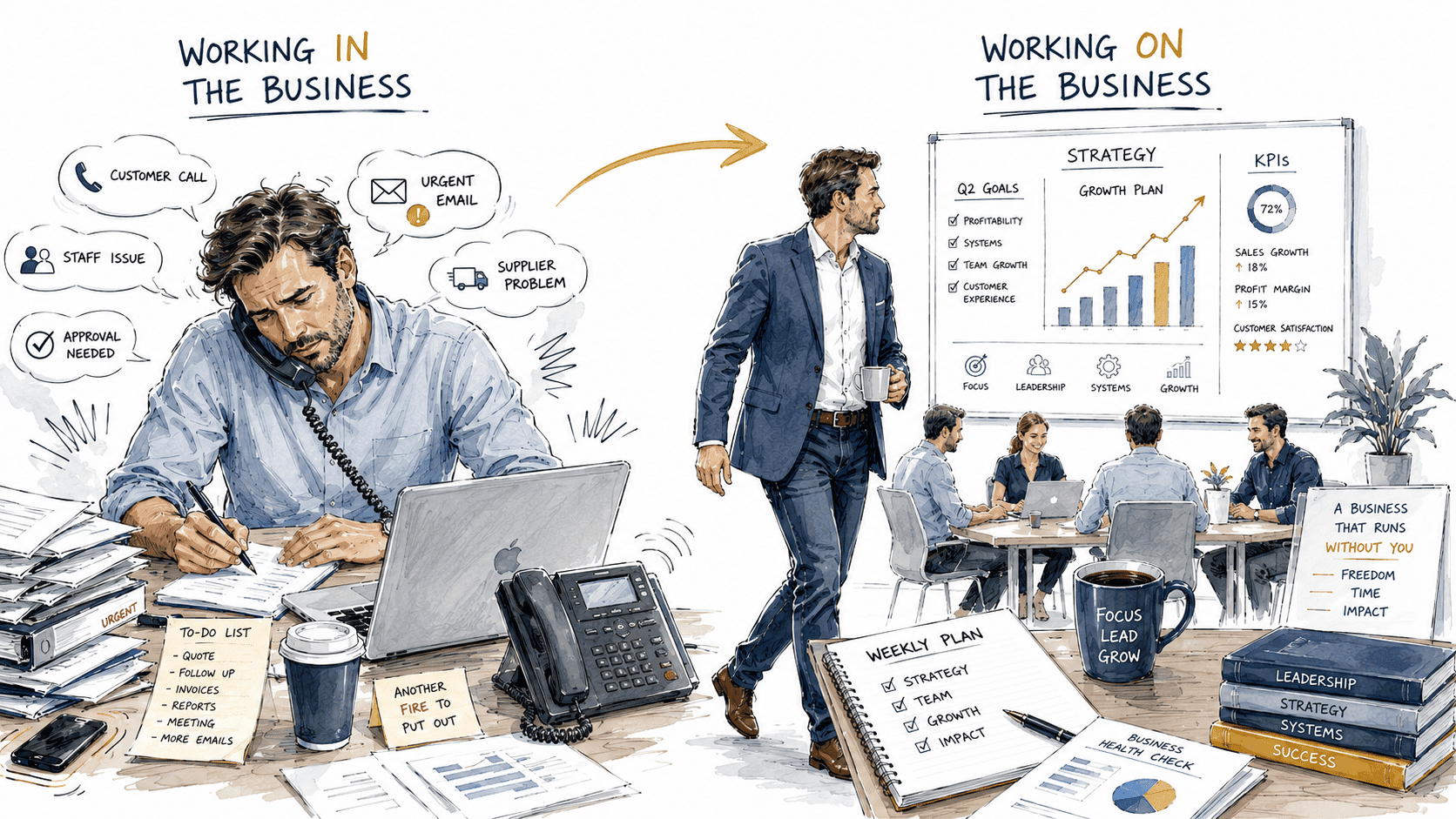
You started your business because you wanted more freedom. And the key to getting it back is learning how to stop working in your business and start working on your business.
More flexibility.
More control over your future.
But somewhere along the way, something changed.
Instead of owning a business, it feels like your business owns you.
Your phone never stops. Your team constantly asks questions. Customers only want to deal with you. Every important decision lands on your desk. Taking a holiday feels impossible.
Most owners recognise at least two of those.
One of the biggest transitions every successful business owner must make is learning the difference between working in the business and working on the business. It’s also one of the hardest.
After coaching Australian business owners for more than 17 years, I’ve found this is where many businesses stop growing. Not because demand disappears, but because the owner becomes the limiting factor.
What’s the Difference Between Working In and Working On Your Business?
Working in your business means you’re involved in the day-to-day operations. You’re answering customer enquiries, solving staff problems, preparing quotes, managing suppliers, completing administration, handling complaints, and approving every decision. Without you, nothing moves.
Working on your business is different. Instead of completing the work, you’re improving the business itself: strategy, leadership, financial performance, systems, team development, marketing, and long-term growth.
A tradesperson swings the hammer. A business owner builds the company that allows dozens of people to swing hammers successfully. That’s a completely different role.
If you’re currently trying to scale your business while still doing everything yourself, I recommend reading How to Scale a Business: What Actually Has to Be in Place First. It covers why sustainable growth starts with changing the way you lead, not simply working harder.
Why Most Business Owners Get Stuck
In the early days you were the salesperson, the technician, the marketer, the bookkeeper, the customer service department. It worked, until it didn’t.
Growth creates complexity. More customers. More staff. More decisions. More moving parts. Unfortunately, many owners continue operating exactly as they did when the business was one-tenth the size. That’s when the cracks begin appearing.
Five Signs You’re Still Working In Your Business
1. Every Decision Comes Through You
Your team asks permission before making even small decisions. Questions like “Can we order this?” or “Should we refund this customer?” might seem harmless, but multiply them by twenty or thirty each day and imagine the lost productivity. When every decision waits for you, your business slows down.
2. Holidays Feel Impossible
Ask yourself: could you disappear for two weeks without checking your phone? If the answer is no, your business still depends on you. Many owners proudly say, “My clients only deal with me.” While that may sound like excellent customer service, it’s one of the biggest risks in the business.
3. You’re Constantly Putting Out Fires
Every day feels reactive. You arrive with a plan, then spend the rest of the day solving unexpected problems. By Friday you’ve been incredibly busy, yet your business hasn’t really moved forward. Firefighting creates the illusion of productivity. Leadership creates progress.
4. Your Team Waits Instead of Leads
If your employees constantly wait for instructions, they never develop confidence. Over time they stop thinking for themselves, eventually believing it’s easier to ask the boss. Without realising it, you’ve trained them to depend on you. The goal isn’t to build employees who follow instructions. It’s to build leaders who solve problems.
5. Your Revenue Depends on You
If you stop working, does revenue stop too? That’s one of the clearest indicators you’re still self-employed rather than building a scalable business. A sustainable business generates value even when the owner steps away.
That’s why understanding The 5 Business Growth Stages Every SMB Owner Must Navigate is so important. Every stage requires a different leadership style, and the shift from operator to leader is one of the biggest transitions you’ll ever make.
Why Letting Go Feels So Difficult
Most owners already know they should delegate. So why don’t they? Because letting go feels uncomfortable. You might recognise some of these thoughts:
- “It’ll be quicker if I do it myself.”
- “Nobody will do it as well as I can.”
- “I don’t have time to train people.”
- “If something goes wrong, it’ll come back to me.”
They’re understandable. But they’re also the beliefs that keep businesses small. Delegation isn’t about lowering standards. It’s about creating systems that allow other people to achieve those standards consistently.
The Hidden Cost of Doing Everything Yourself
Doing everything yourself doesn’t just affect your workload. It affects your entire business. Over time you’ll notice slower growth, poor staff retention, lower morale, missed opportunities, customer delays, decision fatigue, and burnout.
Eventually, you become the biggest obstacle to the very growth you’re trying to achieve. That’s exactly why many businesses hit a plateau. If your revenue has stopped increasing despite everyone working hard, read Why Your Business Has Hit a Revenue Ceiling (And How to Break It). Often the biggest barrier isn’t marketing. It’s leadership.
Leadership Requires a Different Job Description
Your value as a business owner isn’t measured by how many emails you answer or how many customer issues you solve. Your value comes from improving the business.
That means spending more time coaching your team, improving systems, reviewing KPIs, building relationships, planning growth, and making strategic decisions. Your business doesn’t need another employee. It needs a leader.
A 7-Step Framework to Start Working On Your Business
Making the transition from operator to business leader doesn’t happen overnight. It’s a gradual process. Every small step you take reduces your dependency on the business and increases your capacity to lead it.
Step 1: Audit Where Your Time Really Goes
Most business owners think they know how they spend their time. Very few actually do. For one week, record every significant task you complete, then divide them into three categories: tasks only you can do (strategy, key partnerships, financial review, leading senior team members); tasks someone else could do with training (preparing quotes, scheduling, customer follow-up, administration); and tasks nobody should be doing (automate or eliminate these).
Step 2: Stop Solving Every Problem Yourself
When your team brings you a problem, resist the temptation to immediately provide the answer. Instead ask: “What do you think we should do?” or “What options have you considered?” Over time your team develops confidence. Eventually they stop bringing problems and start bringing solutions. That’s leadership development in action.
Step 3: Build Systems Instead of Heroes
Many businesses rely on one or two people who “know how everything works.” That’s risky. Instead, create systems anyone can follow: document sales processes, customer onboarding, quoting procedures, staff induction, weekly reporting, and customer service standards.
Strong systems create consistent outcomes. Once they’re in place, the next step is building a self-managing team that runs those systems without needing you in every decision.
If systems are currently holding your business back, read Why Every Growing Business Needs Better Systems.
Step 4: Delegate Outcomes, Not Just Tasks
One of the biggest delegation mistakes owners make is handing over work without handing over responsibility. Instead of saying “Can you do this?” start saying “I’d like you to own this outcome.” Ownership changes behaviour. It encourages initiative, accountability and better decision-making.
If delegation is something you struggle with, our guide on How to Delegate Effectively as a Small Business Owner walks through practical strategies for letting go without sacrificing quality.
Step 5: Develop Leaders, Not Followers
As your business grows, you can’t be the only leader. Identify people within your team who consistently solve problems, take initiative, support others, communicate well, and demonstrate accountability. Invest in developing them. Future growth depends far more on leadership capacity than headcount.
If you want to build your own leadership capability at the same time, read Leadership Skills Every Small Business Owner Must Develop. It covers the five core skills that make the biggest difference in a growing business.
Step 6: Protect Time for Strategic Thinking
Many business owners spend every day reacting. Very few spend enough time thinking. Block out dedicated time each week to work on your business: reviewing financial performance, marketing, customer feedback, team development, growth opportunities, and business risks. Treat this appointment as seriously as you would a meeting with your biggest client.
Step 7: Review Your Progress Every Quarter
Leadership isn’t something you master once. Every 90 days, ask yourself: Am I spending more time on strategy than operations? Is my team making more decisions independently? What still depends on me? What’s the next bottleneck?
If you haven’t created a structured roadmap, read How to Write a Business Growth Plan for Your Small Business for a practical framework for setting quarterly priorities.
What Working On Your Business Looks Like
When owners finally make the shift, they often tell me they feel like they’ve got their business back. Instead of spending every day reacting, they’re reviewing business performance, coaching their team, planning for future growth, improving profitability, developing systems, building relationships, and exploring new opportunities. Ironically, they often work fewer hours while achieving better results, because they’ve moved from doing the work to leading the business.
The Long-Term Benefits
Learning to work on your business creates measurable outcomes: faster decision-making across the team, improved customer experience, higher staff engagement, better profitability, stronger business systems, increased business value, and more personal freedom. Perhaps most importantly, your business becomes an asset rather than a job.
Ready to Step Out of the Day-to-Day?
If you feel like your business can’t function without you, it’s time to change that. Book a Discovery Call with Mark and discover how to build a business that gives you greater control, stronger profits and more freedom.
Frequently Asked Questions
What does “working on your business” mean?
Working on your business means focusing on strategic activities that improve the business rather than completing daily operational tasks. This includes leadership, planning, financial management, systems, team development and long-term growth.
What’s the difference between working in and working on your business?
Working in your business involves day-to-day operations: serving customers, completing jobs and solving immediate problems. Working on your business focuses on improving systems, developing your team and creating sustainable growth.
Why do business owners struggle to let go?
Many owners believe they’re the only person who can complete tasks correctly or efficiently. Without systems, delegation and leadership development, they become the bottleneck that limits business growth.
How can I stop being the bottleneck in my business?
Start by documenting processes, delegating responsibility, developing leaders, measuring KPIs and setting aside regular time to focus on strategic planning instead of daily operations.
How does a business coach help with working on your business?
A business coach helps you identify which tasks only you can do, build the systems and team structure to delegate the rest, and holds you accountable to making the shift. Most business owners know what they should do. A coach makes sure they do it consistently, with an outside perspective that cuts through the daily noise.