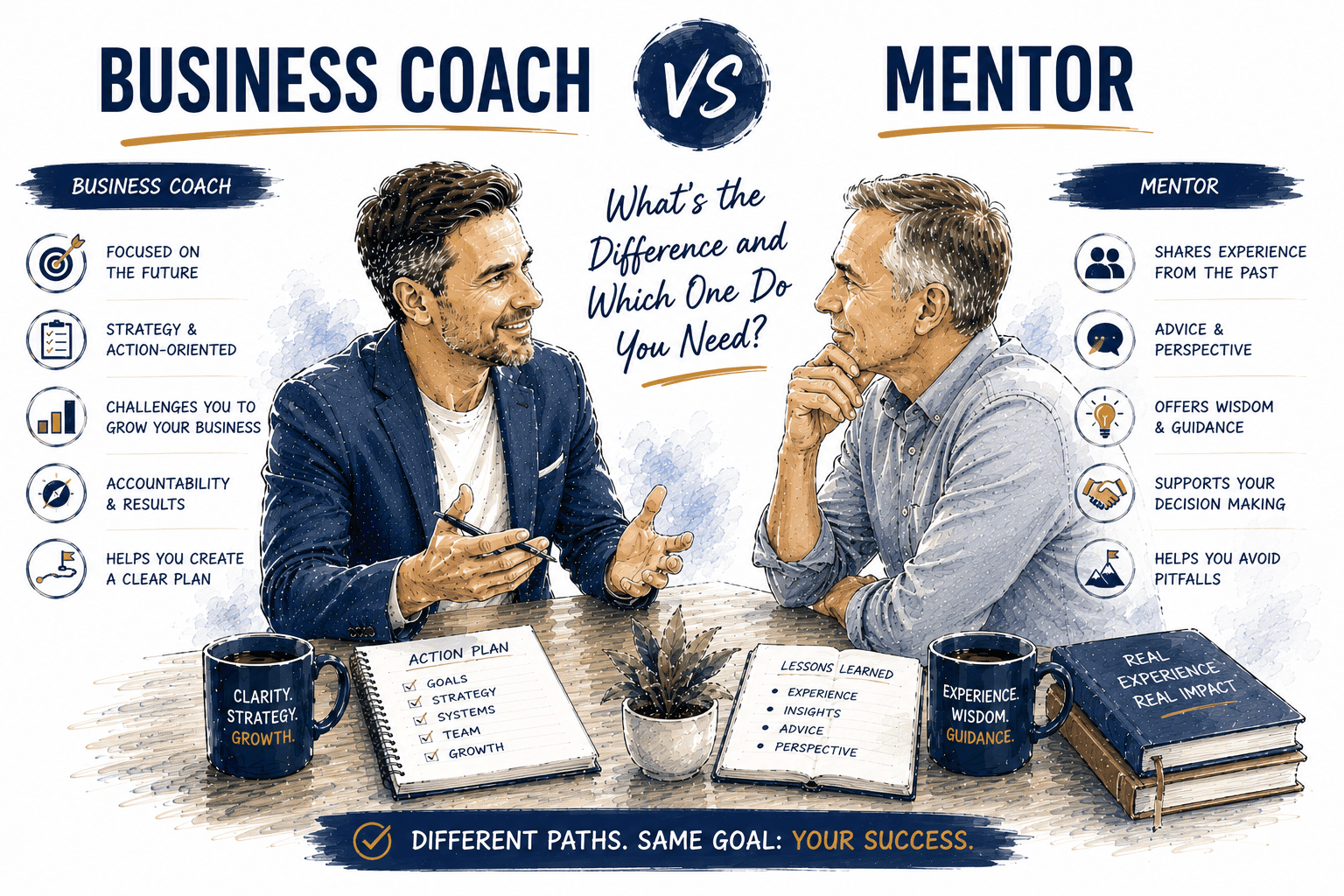
Most small business owners reach a point where they know they need outside help, but they’re not sure what kind. You’ll hear “coach” and “mentor” used interchangeably, but they’re not the same thing. Choosing the wrong one wastes time, money, and momentum.
The good news? Once you understand the difference, the right choice becomes clear. And as you’ll see, sometimes the answer is both.
Here’s what each role actually does, the five key differences, and how to decide which type of support your business needs right now. → Read our complete guide to small business mentoring
Key Takeaways
- A business coach uses structured frameworks and questioning to help you find your own answers and take action.
- A business mentor shares their real-world experience and gives direct guidance based on what they’ve lived through.
- In 2026, 87% of coaching clients report a positive ROI, with an average return of 7x the cost of engaging a coach (ICF / PricewaterhouseCoopers).
- The best business support often combines both: structured coaching AND experienced mentoring.
What Is a Business Coach?

In 2026, the ICF 2025 Global Coaching Study reported that the global coaching industry now generates USD $5.34 billion in annual revenue, a 17% increase since 2023, driven by small and medium business owners seeking structured, results-focused support. A business coach is a trained professional who works with you through a structured process, using questions, frameworks, and accountability systems to help you take consistent, purposeful action.
The key word is structured. A coaching engagement has clear goals, defined timelines, and regular accountability check-ins. The coach doesn’t hand you a to-do list. They use skilled questioning to help you think clearly, identify what’s holding you back, and commit to the actions that will actually move your business forward.
What a business coach is not: a consultant who builds you a plan and disappears, a therapist, or a cheerleader. A good coach holds you accountable and challenges your thinking, especially when it’s uncomfortable. That challenge is where growth happens.
Common coaching focus areas:
- Setting and achieving specific, measurable business goals
- Improving leadership, communication, and decision-making
- Building accountability and consistent follow-through
- Working through a specific plateau or bottleneck
- Structuring your time, team, and systems for scale
According to the ICF and PricewaterhouseCoopers, 87% of coaching clients report a positive return on investment, and the average ROI is estimated at 7x the cost of engaging a coach (ICF Coaching ROI Statistics, 2024). For small business owners, few investments offer that kind of return.
What Is a Business Mentor?

In 2024, MentorcliQ’s Mentoring Impact Report found that median profits for companies with mentoring programs were more than 2x higher than those without. A business mentor is an experienced business person (typically someone who has already built, scaled, or run businesses) who shares their knowledge, perspective, and real-world experience to guide you through challenges.
Where a coach asks questions, a mentor often gives direct answers. They’ve been where you’re going. When you’re facing a decision about your first hire, a difficult client, a pricing problem, or a major expansion, a mentor draws on their own experience to help you navigate it without having to learn everything the hard way.
What a mentor is not: a coach who runs a structured curriculum, a consultant you pay for a report, or someone who does the work for you. Great mentors share what they’ve learned, including their mistakes, so you benefit from their experience without repeating it.
Common mentoring focus areas:
- Navigating major business decisions with confidence
- Getting industry-specific guidance from someone who’s done it
- Building long-term strategy and vision for the business
- Having a trusted sounding board when things get hard
- Shortcutting the learning curve in the early stages of business
And the impact of great mentoring shows up in the data: in 2024, a CNBC / SurveyMonkey survey found that 90% of workers who have a mentor report being happy in their jobs, a figure that reflects how powerfully experienced guidance reduces the isolation and uncertainty of running a business alone.
→ Learn more about business mentoring with Mark
Business Coach vs Mentor: 5 Key Differences
So what actually separates a coach from a mentor? Understanding the distinction comes down to five practical differences. Both are valuable. They just work differently.
| Factor | Business Coach | Business Mentor |
|---|---|---|
| Knowledge flow | Draws out your answers through questioning | Shares their answers from experience |
| Relationship style | Structured sessions, defined goals, formal accountability | Conversational, flexible, built around your immediate needs |
| Expertise | Expert in the process of growth and change | Expert in their field: business, industry, or domain |
| Goal focus | Specific, measurable performance improvement | Broader growth as a business owner and leader |
| Time horizon | Time-bound (3, 6, or 12 months) | Often ongoing, evolving as your business grows |
Neither is better than the other. They serve different needs. The right question isn’t “coach or mentor?” but “what does my business need most right now?”
When Should You Choose a Business Coach?
A business coach is the right choice when you have a specific plateau, problem, or goal, and you need structure, accountability, and a clear process to break through it. In 2026, more than 50% of coaching clients are employer-sponsored or business-funded (ICF 2025 Global Coaching Study), which reflects how mainstream coaching has become as a growth tool for business owners who are serious about results.
You probably need a business coach if:
- You keep hitting the same walls and can’t figure out why
- You know what you should be doing, but you’re not doing it consistently
- You’re making decisions reactively rather than strategically
- You want to improve a specific skill: leadership, sales, time management, financial management
- You need someone to hold you accountable, not just give you advice
The accountability element is what separates coaching from a business book or a podcast. A coach checks in, challenges you, and holds you to what you committed to, week after week. That consistency is what creates change. → Learn more about accountability in business
When Should You Choose a Business Mentor?
A mentor is the right choice when you’re navigating territory you haven’t been in before, and what you really need is someone who has. In a 2024 CNBC and SurveyMonkey survey, 90% of workers with a mentor reported being happy in their jobs, a figure that reflects how powerfully a mentor’s guidance reduces the isolation and uncertainty that comes with running a business alone.
You probably need a business mentor if:
- You’re making a major decision (hiring, expanding, pivoting) and want to learn from someone who’s done it
- You feel isolated as a business owner and want a trusted sounding board
- You’re in the early stages and want to shortcut the learning curve
- You need industry-specific wisdom, not just general frameworks
- You’re working on long-term strategy and vision, not just short-term performance
The biggest thing a mentor offers is compressed experience. They’ve already made the mistakes you’re about to make, and they can help you avoid them. → Set stronger goals with Mark’s goal-setting framework
Do You Have to Choose? Why the Best Results Come From Both

Here’s what most articles on this topic miss: the coach vs mentor debate is often a false choice. The most effective business support combines both: structured coaching frameworks and the real-world wisdom of someone who has actually built and run businesses.
Mark has spent 35+ years building, running, and advising businesses across Australia. Since 2007, he’s worked with hundreds of small and medium business owners as both a coach and a mentor, and that combination is deliberate. Every engagement includes structured coaching frameworks: clear goal-setting, accountability check-ins, business systems, and performance tracking. But it also includes direct, experience-based guidance drawn from decades of real business life.
That dual approach is rare. Most coaches have strong process skills but limited hands-on business experience. Most mentors have deep experience but no structured framework to turn insights into consistent action. Working with someone who genuinely does both means you get accountability and wisdom, not one or the other.
Mark’s perspective: “Most of my clients come in thinking they need one or the other. What they actually need is someone who can switch between the two: asking the right questions when they need to think, and giving a direct answer when they need to act. That’s what I’ve spent 35 years learning how to do.”
In 2026, the ICF’s global data confirms coaching demand is growing fastest in the SME sector, because business owners are realising that structured support with experienced guidance is one of the highest-leverage investments they can make in their business.
Ready to work with a business coach and mentor who does both?
Book a free Clarity Call with Mark. No obligation, just a real conversation about where your business is and where you want it to go.
Frequently Asked Questions
Is a business coach the same as a business consultant?
No. A consultant typically diagnoses a problem and delivers a plan or report. A coach works with you over time to develop your own thinking, build your capabilities, and hold you accountable to action. Consulting is done to you; coaching is done with you. According to the ICF 2025 Global Coaching Study, 87% of coaching clients report positive ROI, largely because coaching drives sustained behaviour change, not just a one-off recommendation.
How much does a business coach cost versus a mentor?
Business coaching is a paid professional service. Fees in Australia typically range from $300 to $1,500+ per month depending on the coach’s experience and engagement structure. Mentoring is often informal and unpaid, though structured mentoring programs may involve a fee. The MentorcliQ 2024 Mentoring Impact Report found companies with mentoring programs recorded 2x+ higher median profits, making even a paid mentoring arrangement highly cost-effective.
Can one person be both a coach and a mentor?
Yes, and the most effective business support professionals often combine both roles. An experienced coach who has also built and run businesses can draw on their own experience (mentoring) while running structured, accountable sessions (coaching). In Mark’s case, 35+ years of real business experience sits alongside a structured coaching framework, giving clients both the process and the perspective.
How long does business coaching typically last?
Most coaching engagements run 3 to 12 months, though many business owners choose to continue once they see results. According to the ICF 2025 Global Coaching Study, more than 50% of coaching clients are sponsored for repeat or extended engagements, which shows that once business owners experience coaching, they keep investing in it. → See how Mark’s coaching engagements are structured
Do I need a coach or mentor with industry-specific experience?
Not always. A great business coach with strong fundamentals (goal-setting, accountability, team building, financial management, leadership) can deliver significant results across industries. The ICF 2025 Global Coaching Study found 72% of coaching clients report improved team engagement regardless of industry. That said, a mentor with direct industry experience adds a layer of contextual insight that general coaching can’t replicate. When you find both in one person, that’s the strongest possible combination.
The Bottom Line
The coach vs mentor question comes down to what your business needs most right now. If you need structure, accountability, and a clear process to break through a specific plateau, you need a coach. If you need wisdom, experience, and a trusted sounding board, you need a mentor. And if you need both?
Mark has spent 35+ years doing exactly that: combining structured coaching with real-world business experience to help Australian small and medium business owners build more profitable, structured, and scalable businesses.
If you’re ready to grow with real support behind you, book a free initial chat with Mark today. No hard sell. Just an honest conversation about where your business is and where you want it to go.
Sources
- International Coaching Federation (ICF), Coaching Statistics: The ROI of Coaching in 2024, retrieved 2026-09-03, coachingfederation.org
- International Coaching Federation (ICF), 2025 Global Coaching Study: Coaching as a Strategic Advantage, February 2026, retrieved 2026-09-03, coachingfederation.org
- MentorcliQ, 2024 Mentoring Impact Report, retrieved 2026-09-03, mentorcliq.com
- MentorcliQ, 40+ Definitive Mentorship Statistics 2025, retrieved 2026-09-03, mentorcliq.com
- CNBC / SurveyMonkey, workplace mentoring survey, cited by MentorcliQ, 2024