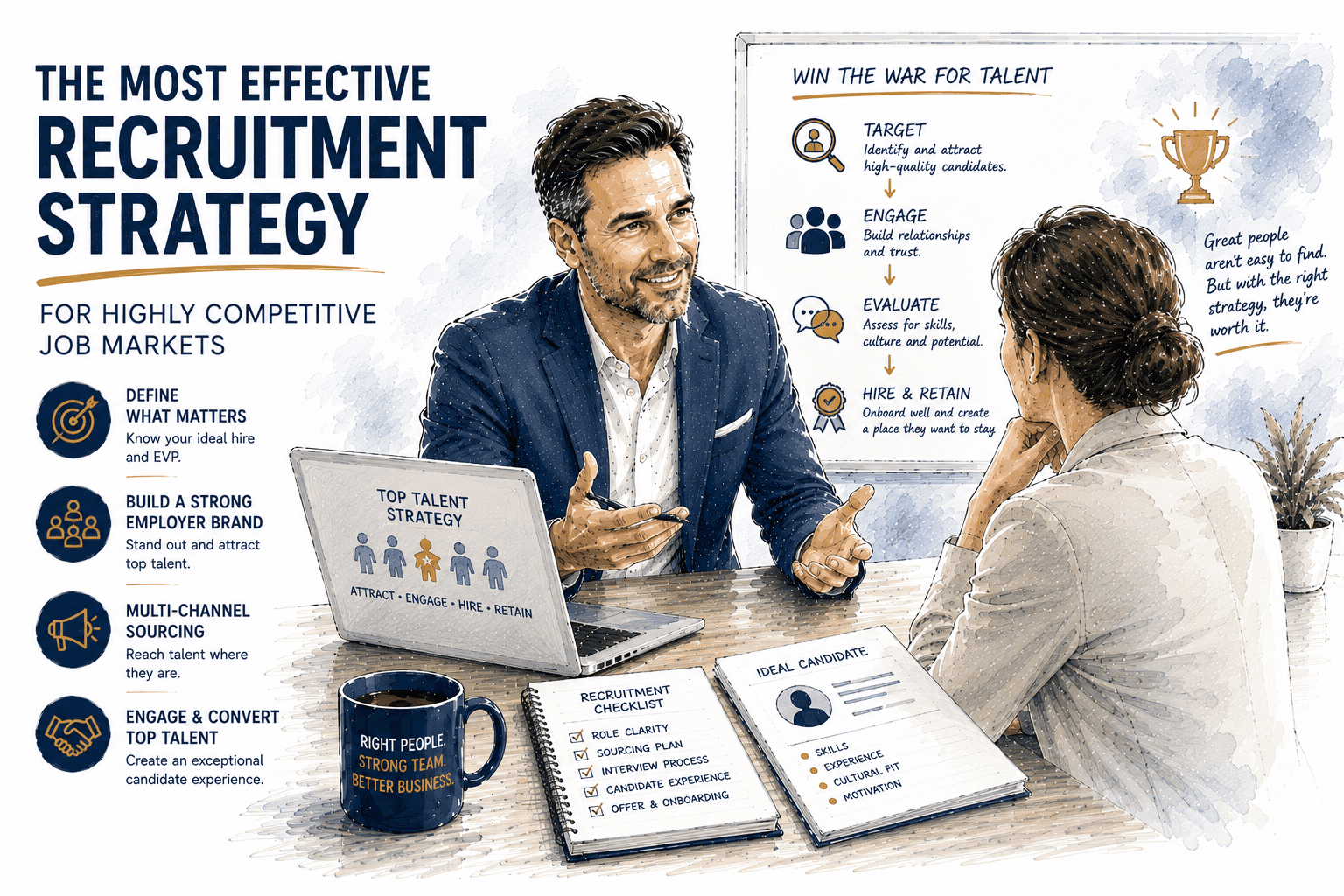
Just like the housing market, recruitment swings between a buyer’s market and a seller’s market. Sometimes you have more applicants than you know what to do with. Other times, there’s not an eligible candidate in sight. In a tight labour market, which Australian small businesses have experienced significantly since 2021, employers are in fierce competition for top talent.
When you have jobs and no one to fill them, it becomes a make-or-break moment for your business. Can you keep growing, or will you be forced to scale back because you simply don’t have the team to move forward?
With 35+ years in business development, I’ve helped businesses expand and hire well even in tight labour markets. The secret is a structured recruitment strategy: not scrambling when a vacancy opens, but building a pipeline before you need it. Here are my top tips.
7 Recruitment Strategy Tips for Small Business Owners
1. Look for Passive and Active Candidates
The best candidate for your role might be unemployed and actively job hunting, or they could be happily employed and not looking at all. To run an effective recruitment strategy, you need to speak to both groups. Post on job boards to reach active candidates. Use LinkedIn and direct outreach for passive ones. And invest in your employer brand consistently, so when the right people do look, your business is already on their radar.
2. Write a Job Description That Actually Sells the Role
Candidates scroll through dozens of job ads. You have seconds to catch their attention. The balance to strike: be honest about the responsibilities (candidates see through vague language immediately), but lead with what makes the opportunity compelling. What training will they get? What does growth look like? Why do your current team members enjoy working there? A strong job description is part marketing, part contract: it attracts the right people and filters out the wrong ones at the same time.
3. Make Applying Simple
People abandon online purchases when checkout is too complicated. The same happens with job applications. A lengthy, confusing process loses good candidates, not just weak ones. Aim for a clean, mobile-friendly careers page with a straightforward form, and be clear about what happens next after someone applies. The easier you make it, the more qualified people complete the process.
4. Use Video to Show Your Culture
Short-form video has changed how people research employers. A two-minute video showing your team, your workplace, and what a typical day looks like gives candidates information a job description never can. It doesn’t need to be produced. Authenticity works better than polish here. If candidates can see themselves in your business before they apply, you’ll attract better-fit applicants from the start.
5. Discuss Salary Early
One of the most common time-wasters in hiring is going deep into an interview process only to find the salary expectations are miles apart. Be upfront early. It’s a sign of respect, and it protects both parties’ time. If a candidate receives a counteroffer elsewhere, be clear about what you can offer, whether that’s a sign-on arrangement, an earlier review, or other benefits. Know your position before you need to respond.
6. Build an Employee Referral Programme
Your existing team is your best recruitment channel. Good people tend to know other good people, and a referred hire already comes with a character reference from someone you trust. Set up a simple incentive: a reward when a referred candidate is hired and stays past their probationary period. It doesn’t need to be large; recognition and a modest bonus go a long way in a small business environment.
7. Be Flexible Where It Counts
The businesses that attract strong candidates in a tight market are the ones that have built a reputation as a genuine place to work. That means flexible arrangements where the role allows, clear pathways for growth, and a culture where people are treated with respect. You don’t need to compromise on standards, but you do need to compete on culture as well as compensation.
Recruitment Is a Leadership Problem First
Most small business owners treat recruitment as an emergency: they only start when someone leaves. The businesses that hire well consistently treat it as an ongoing function, not a one-off event. That means maintaining a short list of potential candidates, staying visible as an employer, and being clear on exactly what you need before a vacancy forces a rushed decision.
If your team keeps turning over, or you keep hiring people who aren’t quite right, the recruitment strategy is often a symptom of a team building or leadership issue underneath it. Fixing the hiring process without addressing those foundations tends to produce the same results faster.
Work With a Business Coach to Improve Your Hiring
I’ve worked with hundreds of Australian small business owners on exactly these challenges: building teams in competitive markets, reducing turnover, and creating the structures that make good people want to stay. If your hiring isn’t working, let’s talk about what’s actually driving it.
Book a free initial chat and we’ll look at where your recruitment strategy is costing you time, money, and momentum.