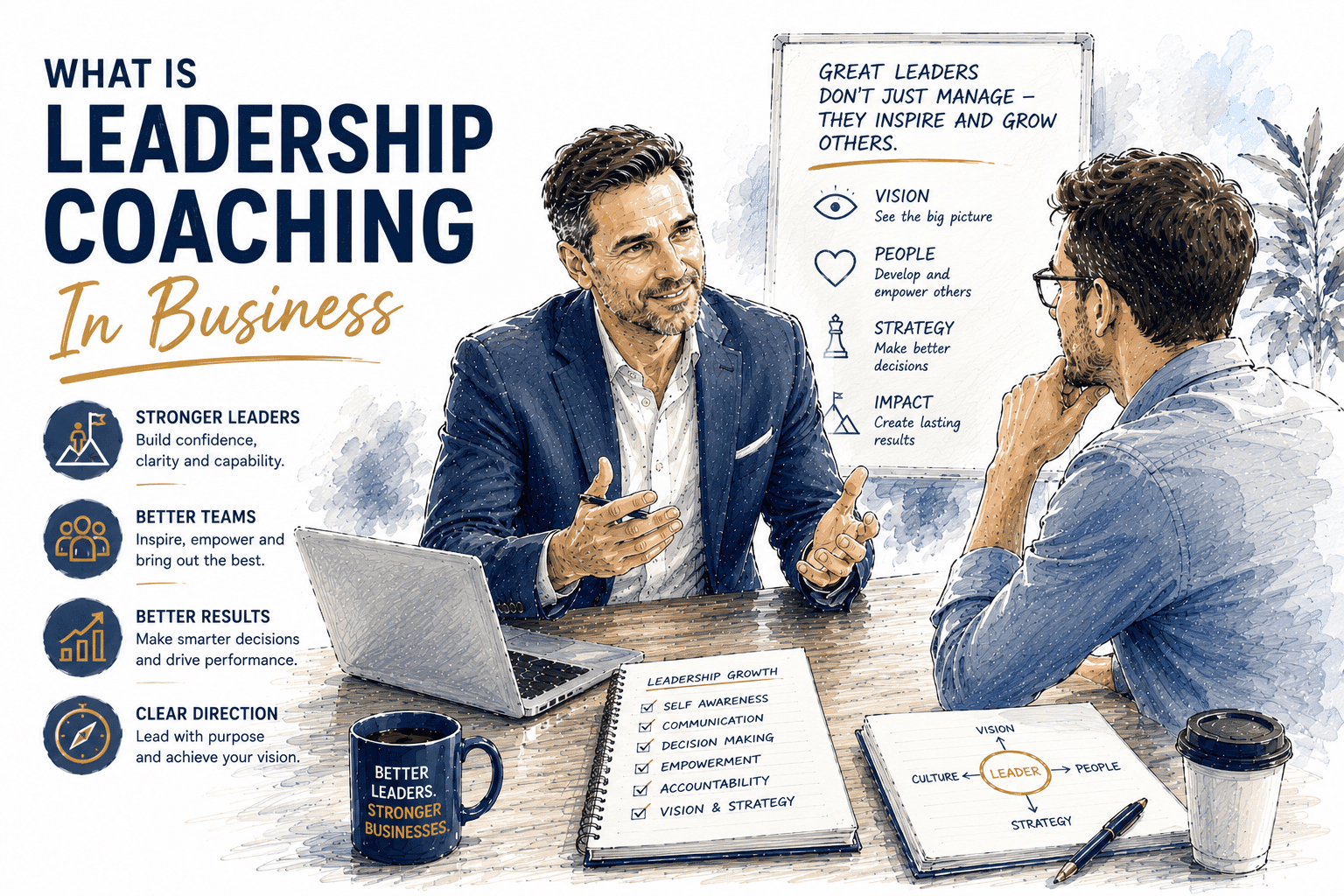
Leadership coaching in business is a one-on-one process where a coach works with a business owner or leader to develop the specific skills, habits, and mindset needed to lead a team more effectively. Unlike a general business coach who focuses on strategy, pricing, or systems, leadership coaching focuses specifically on the person leading the business, and how they show up for their team.
Mark has been providing leadership coaching to Australian business owners since 2007. In his experience, the team is almost always a direct reflection of the owner’s leadership. Fix the leadership, and the team performance follows.
What Leadership Coaching Actually Covers
Leadership coaching is not about theory or textbook frameworks. The areas Mark works on with business owners are practical and specific:
- Communication: how you set expectations, give feedback, and run team meetings
- Delegation: what to hand over, to whom, and how to do it without losing quality
- Accountability: how to hold people to their commitments without becoming the person everyone avoids
- Decision-making: when to decide, when to consult, and how to stop decisions piling up on your desk
- Culture: the environment you create by the way you behave, not the values on the wall
These aren’t soft skills in the dismissive sense. They’re the skills that determine whether your team performs or coasts, and whether the business can grow beyond what you can personally manage.
Why Leadership Coaching Matters for Small Business Owners
Most small business owners were never trained as leaders. They became good at their trade or profession, built a business around that skill, and then found themselves managing people, often without any preparation for it.
The result is a business where the owner is the de facto solution to every problem, the decision-maker for every question, and the bottleneck on every piece of growth. Leadership coaching gives you the skills to change that dynamic.
According to the Australian Institute of Company Directors, leadership capability is one of the most consistently cited gaps in Australian SME growth, ahead of capital and market access. The issue isn’t opportunity. It’s the person at the top.
If you want to read more about the specific leadership skills that make the biggest difference in a growing business, see Leadership Skills Every Small Business Owner Must Develop.
Leadership Coaching vs Business Coaching: What’s the Difference?
Business coaching covers a broad set of commercial issues: pricing, cash flow, systems, marketing, team structure. Leadership coaching is a specific strand within that, focused on the owner’s effectiveness as a leader.
In practice, the two overlap. A business owner who is struggling with delegation, accountability, or team performance is facing a leadership problem, even if they think they have a team problem. Mark’s coaching typically integrates leadership development with business strategy, because the two can’t be cleanly separated.
What Leadership Coaching Looks Like in Practice
Leadership coaching with Mark happens in fortnightly one-on-one sessions. Each session is focused on a specific challenge the owner is facing: a difficult team member, a communication breakdown, a decision they’re avoiding, or a pattern they keep repeating.
Between sessions, there are clear actions. The accountability isn’t just about strategy. It’s about behaviour. What are you going to do differently this week? How will you handle that conversation you’ve been putting off? What does it look like to lead your team through this change?
The work is direct and specific. Mark isn’t there to validate. He’s there to help you see what you can’t see yourself, and to change what isn’t working.
Signs You Need Leadership Coaching
You might benefit from leadership coaching if:
- Your team constantly brings problems to you instead of solving them independently
- You’ve had the same performance conversation with someone more than twice
- Team morale is low and you’re not sure why
- You avoid difficult conversations and hope the problem resolves itself
- You’ve hired people but still end up doing most things yourself
- Staff turnover is higher than it should be
Most of these are symptoms of a leadership gap, not a team problem. Building a self-managing team starts with you developing the leadership skills that make it possible.
A Real Example of Leadership Coaching in Action
One of Mark’s clients ran a professional services firm in Sydney. When she came to him, her team of seven was underperforming. Three people were doing the work of five. Morale was poor. She’d had multiple difficult conversations that hadn’t changed anything.
What became clear early was that the problem wasn’t the team. It was the way she was managing them. Expectations were unclear. Accountability was inconsistent. She was solving problems her team should have been solving themselves.
Over six months of leadership coaching, she changed the way she ran her weekly team meeting, introduced clear accountabilities for each role, and learned to have difficult conversations directly rather than hoping problems would sort themselves out.
Within a year, two of her underperformers had left (on her terms, not theirs), the remaining team was performing significantly better, and she’d hired one new person who thrived from day one. The business hadn’t changed. Her leadership had.
How to Get Started
Leadership coaching works when the owner is willing to look at their own behaviour honestly and make changes. If you’re ready to stop managing by proximity and start leading by design, book a free Discovery Call with Mark. In 45 minutes you’ll have a clear picture of what leadership coaching could address in your business, and whether it’s the right fit.
Frequently Asked Questions
What is leadership coaching in business?
Leadership coaching in business is a one-on-one process where a coach works with a business owner or leader to develop specific skills: communication, delegation, accountability, decision-making, and culture. The goal is to improve how you lead your team so the business can perform without depending on you for every decision.
How is leadership coaching different from general business coaching?
General business coaching covers strategy, systems, pricing, and growth. Leadership coaching focuses specifically on the owner as a leader: their behaviour, communication, and how they develop and manage their team. In practice they often overlap, because leadership problems usually show up as business problems.
How long does leadership coaching take to show results?
Most business owners notice a shift in team dynamics within 3 months of focused leadership coaching. The biggest changes (team accountability, reduced dependence on the owner, improved morale) typically solidify within 6–12 months of consistent application.
Do I need leadership coaching or business coaching?
If your core challenges involve your team (performance, accountability, communication, culture, or retention) leadership coaching is likely the right starting point. If the challenges are more commercial (pricing, cash flow, growth strategy) broader business coaching applies. Often both are needed at different stages.
Can leadership coaching help if my team is small?
Yes. In fact, leadership coaching has the most impact early, before poor habits are established. A business owner with two employees who leads well from the start builds a very different culture than one who waits until they have ten people and a serious team problem to fix.