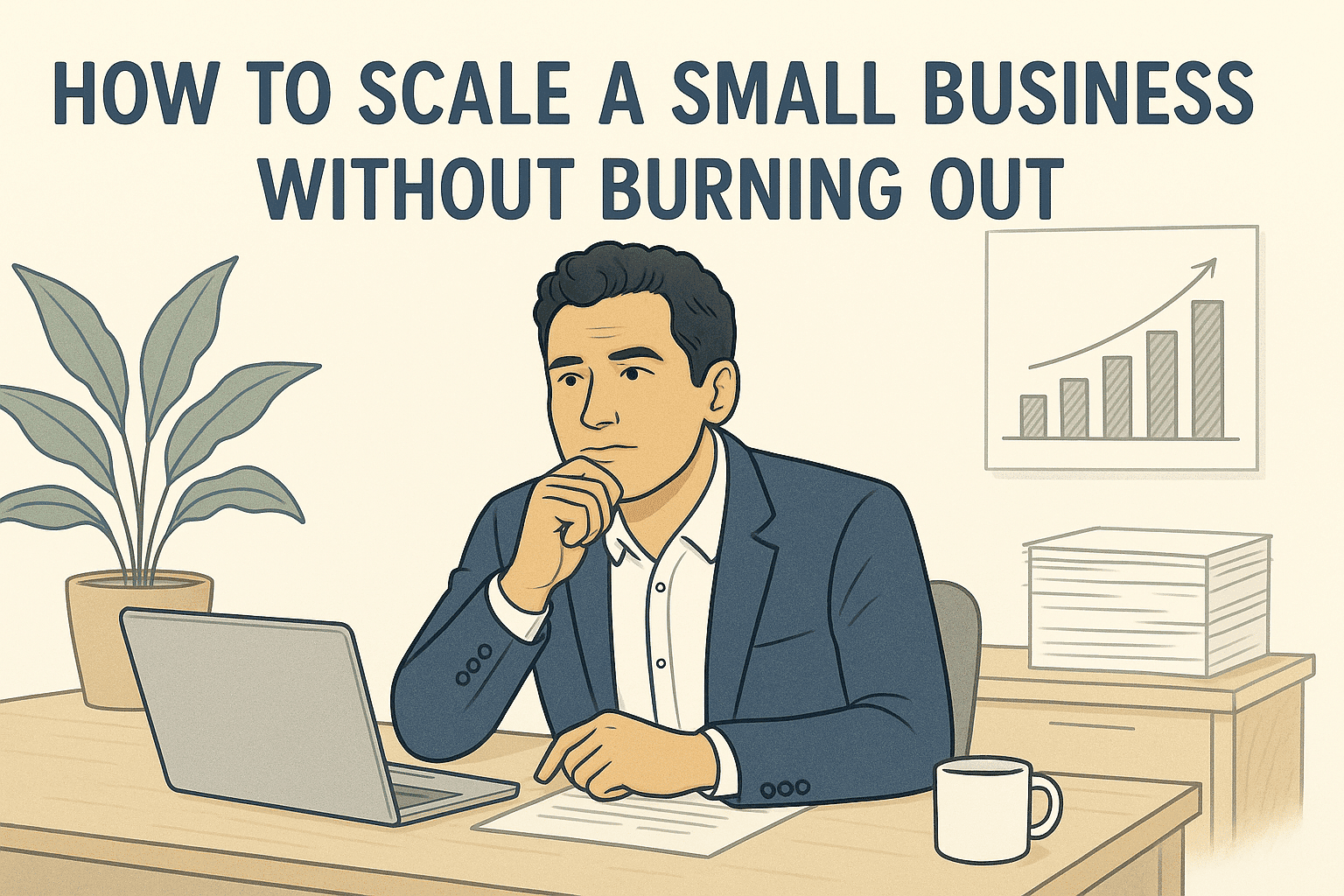
Scale a small business, three words that sound exciting, promising, and if we’re being honest, a bit overwhelming. For many business owners, the idea of growing their business is tied up with long hours, constant pressure, and the nagging feeling that something’s always about to fall through the cracks.
Let’s get real. You didn’t start your business to work longer hours and be constantly stressed. You want to grow, yes, but not at the expense of your health, your family, or your sanity. In this blog, we’ll unpack how to scale a small business without burning out. These are the same strategies I work through with clients every day, and they’re designed for individuals who want practical change, not empty promises.
The Reality of Scaling: More Than Just More
Many business owners think that to scale a small business, they just need to do more. More clients, more staff, more services. But that’s often the fast track to burnout.
Scaling isn’t just about more. It’s about better.
Here’s what I usually see when someone’s pushing for growth:
- They’re still involved in every part of the business
- They don’t trust the team to make decisions
- They’re wearing too many hats: sales, admin, ops, leadership
- Their systems are barely keeping up
If that sounds like you, take a breath. You’re not failing. You’re just stuck in the transition zone, from operator to leader. And that’s where we start.
1. Redefine Your Role
If you want to scale a small business, you need to stop being the bottleneck. That means shifting your identity from “doer” to “leader.”
This isn’t easy. You’ve likely built your business from the ground up. Letting go can feel like dropping the baby.
But here’s the thing, growth depends on trust. And that starts with getting crystal clear on your role.
Ask yourself:
- What should I only be doing?
- What can I delegate?
- Where am I slowing things down?
Start pulling yourself out of the day-to-day by setting boundaries and blocking time for strategic thinking each week.
2. Build Systems That Run Without You
Systems give your business structure. They create consistency, reduce errors, and let your team step up.
Want to scale a small business without chaos? Then your systems need to work whether you’re in the office or not.
Start with these:
- Sales process: Is it repeatable and trackable?
- Onboarding: Can someone else bring on a new team member or client seamlessly?
- Job management: Do your jobs run on a project management platform or from your head?
You don’t need perfect systems overnight. Just aim for progress. Document what you do now, then improve it in chunks.
3. Strengthen Your Team
You can’t scale a small business solo. Your team is either your greatest asset or your biggest stressor.
If your staff relies on you for every answer, it’s time to build a culture of ownership. Here’s how:
- Set clear expectations and KPIs
- Hold regular 1-on-1s focused on growth, not just performance
- Celebrate initiative, even when mistakes happen
- Let go of perfection, focus on progress
When your team knows the “why” behind their work, they show up differently. And when they have real ownership, they help carry the load.
4. Know Your Numbers
Scaling without solid financial insight is like driving with your eyes closed. You need data to make confident decisions.
Get across:
- Your break-even point
- Gross profit per job or service
- Cost of acquiring new clients
- Cash flow forecasts
When you scale a small business, every move gets magnified, good or bad. Clear financial reporting helps you grow with your eyes open.
Don’t just look at the numbers once a quarter. Build habits around weekly check-ins, even if it’s just 15 minutes with your bookkeeper or a financial dashboard.
5. Manage Your Energy (Not Just Time)
Here’s the truth: to scale a small business, you need to look after your most important asset: you.
Working 12-hour days might feel noble, but it’s not sustainable. Burnout doesn’t announce itself. It creeps in through frustration, fatigue, and feeling stuck.
Protect your energy by:
- Setting clear work hours and sticking to them
- Booking non-negotiable time off (yes, even if it’s just an afternoon)
- Learning to say no to the wrong clients or distractions
- Having a sounding board (this is where a coach can really help)
You don’t need to be superhuman. You just need systems and support that take the pressure off.
Real-World Coaching Example
One of my clients, a second-generation electrical business owner from Inner West Sydney, came to me exhausted. He was turning over solid revenue but was still stuck quoting jobs at 9 pm, chasing invoices on weekends, and fixing team issues daily.
We started by mapping out his weekly schedule. Then we removed him from the quoting process entirely by systemising it and training his team lead. He was nervous at first, but after three months, not only was the process working, but he hadn’t done a single quote himself. Revenue continued climbing, but he now gets home for dinner most nights.
That’s what happens when you scale a small business with intention. Not just growth for growth’s sake, but growth that gives back.
Final Thoughts: Growth Without Guilt
You can scale a small business without burning out. But you need to do it on your terms.
That means building a team that backs you, putting systems in place that support you, and creating a business that serves your life, not the other way around.
If you’re feeling stuck or you’ve hit a ceiling, let’s chat. You don’t have to figure it out alone.
Book a Discovery Call
mark@businesscoachmark.com.au
0403 881 105